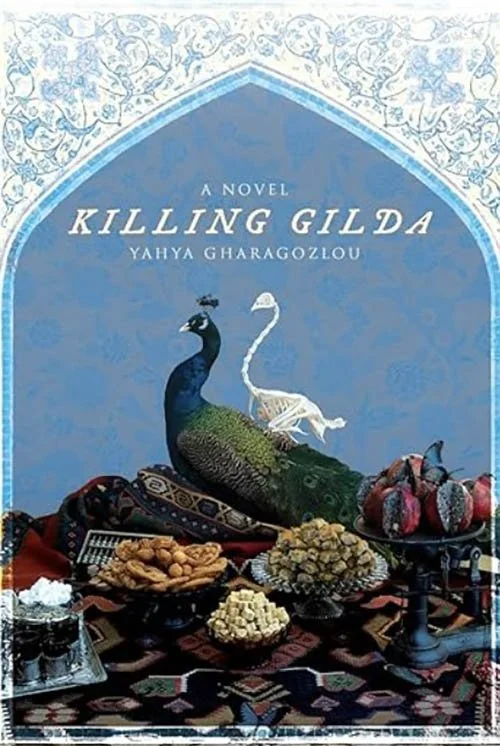
A mistress, a monarchy, and a fatal betrayal
Killing Gilda
A woman enters power and cannot leave unchanged
Gilda is nineteen when she crosses into the Shah’s world and becomes the mistress of Mohammad Reza Shah Pahlavi. Power, at that distance, feels like promise—intimate, intoxicating, almost tender. She begins to imagine a future within it, not yet sensing how power marks those it favors, or how quietly it closes around them.
The narrator, still in love with her, follows the afterimage she leaves behind. His search passes through a private map of desire and discretion—Paris in the orbit of Madame Claude, the alpine glare of St. Moritz, the curated anonymity of Baden-Baden—where bodies, secrets, and loyalties circulate in the same rarefied air. What appears glamorous reveals itself as something more precarious: a system of permissions, transactions, and silences.
Killing Gilda moves along the fault line between seduction and control. It lingers where intimacy becomes leverage, where proximity to power becomes a form of exposure. Set against the final years of a monarchy already beginning to fracture, it is the story of a young woman drawn into a world that promises everything—and withdraws it without warning, leaving behind only traces, questions, and the shape of a life that could not escape its enclosure.
Get the Book
paperback, audiobook, ebook
Praise for Killing Gilda
“A tale of love and power in a dying empire.”
Babak Bagheral · Verified Purchase
Killing Gilda is a captivating narrative that intertwines love, ambition, and political upheaval. Rich in vivid detail, it transports the reader into the luxurious yet suffocating world of the Iranian court. The novel balances intrigue with intimacy, weaving Gilda’s aspirations and the narrator’s heartbreak into a larger story of loyalty, absurdity, and collapse. A poignant exploration of love, sacrifice, and the desire for freedom.
“Transporting… the Persian court brought to life.”
T. Farman-farmaian
As an Iranian who grew up in the shadow of the revolution, I found this book remarkably authentic. It captures, with rare precision, the texture of life in the royal court of Mohammad Reza Pahlavi and Empress Farah. The world is vivid—opulence, spectacle, and quiet tension—rendered through a narrator drawn into its inner workings. A richly detailed and immersive novel.
“A unique and deeply resonant historical narrative.”
Tarlan · Verified Purchase
I was so captivated by this book that I ordered additional copies to share with family and friends. It evokes the texture of remembered stories while offering a compelling window into pre-revolution Iran. Particularly meaningful for those interested in the history and experience of the Persian diaspora.
“Fascinating… charming… an engaging view of a vanished era.”
Nima Isham
A compelling and accessible portrait of a historical moment, told with clarity and grace.
“Intriguing storytelling… beautifully researched.”
Amazon Customer · Verified Purchase
A fluid narrative moving across time, enriched by historical detail. An engaging and
From Killing Gilda
Excerpts:
“Well, he,” I mimicked, pointing to the ceiling, “wants you married inside the week.”
“I know,” she said calmly. She mocked my mimic. “He told me.” She pulled her tongue out, accompanied by a childlike bend of the body. “So, find me a husband quick.”
“What if I told you they want me to marry you?” I lied.
She looked at me with genuine pity. “You? No one would believe it. It would look like a put-up job. Me and you—the thought of it.” She laughed, and then, more quietly: “It must be someone believable. Whoever you pick needs to know he can’t touch me.”
When there is no choice, make the worst choice possible.
She took the sting out. I had to admire G.’s flexibility. She rolled with punches. She looked for a quick win, no more talk of marriage to HIM. The vision had already shifted—to the role of Madame Pompadour.
More From Killing Gilda
“The doctors tell me the bullet lodged itself in a bundle of nerves. Inoperable, they say. A danger to your sex life if they attempt to extract it.”
He or I didn’t know the half of it.
“My bullet exited from here,” he says. He points to his cheek. “And out clean here.” He scratches on his left upper lip. I detect a slight hiss in his speech.
Years later, in a bedroom he used for his romantic interludes, I saw his three-tooth falsie in a glass of water in the bathroom.
My life as a fool at court started soon after my recovery at the hospital. I carry an embalmed memory. I am unwrapping it into thin strips to put it to rest before I go to mine.