The Inheritance of Belief
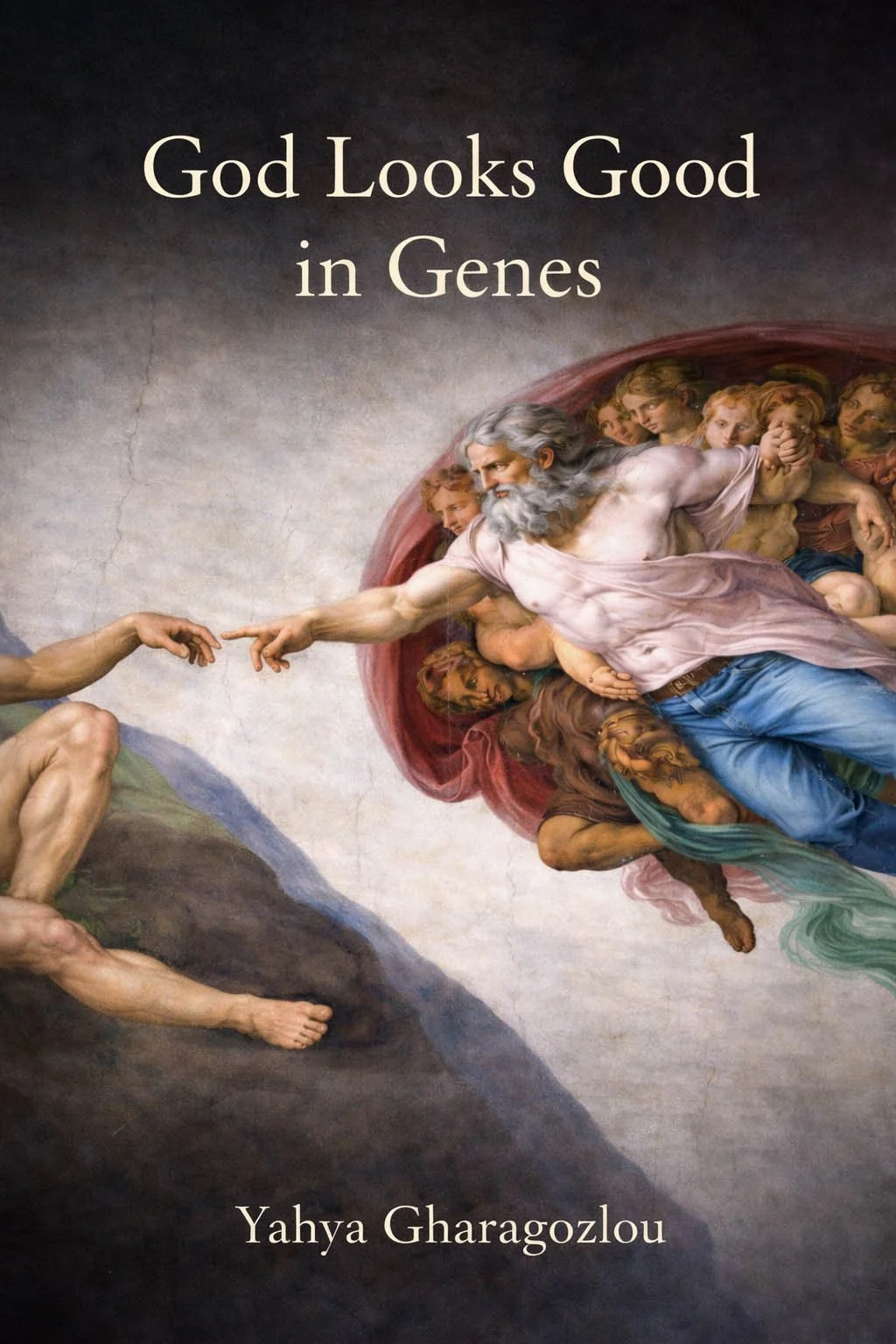
God Looks Good in Genes
A novel of science, belief, and the engineering of meaning
A scientist maps the biology of belief; after her death, a lawyer inherits the burden of its meaning.
A dying scientist writes from a religious hospice outside Cambridge, recounting a discovery that alters how we understand belief itself. What begins as an inquiry into the biology of meaning leads to the identification of a genetic mechanism that shapes the mind’s appetite for agency, purpose, and uncertainty. As the line between understanding and intervention dissolves, knowledge becomes power—and power begins to ask what it is allowed to change. After her death, the narrative passes into the hands of Julian Squire, a London solicitor tasked with settling her estate and safeguarding her papers. Through his precise, controlled correspondence, the story shifts from private confession to public consequence, as he becomes the reluctant custodian of a discovery the world is not prepared to absorb.
For Agents & Publishers
Synopsis GOD LOOKS GOOD IN GENES
It’s a literary novel about science, belief, and the danger of making human meaning biologically legible.
At the end of her life, Linh Tran writes to her poet friend Noema from a religious hospice outside Cambridge. The voice is intimate, amused, unsparing, and shadowed by hindsight. Linh sets out to tell the story of research that changed the world. She and her colleagues belonged to a generation of scientists who turned away from the old, blunt argument over whether religion was true or false and asked instead what kinds of minds experience the world as charged with agency, presence, and significance. Their work began with the measurable habits of belief: pattern sensitivity, agency detection, absorption, and tolerance for uncertainty.
That inquiry leads them into the neglected “junk” regions of DNA, where they identify something more subtle and more dangerous than a so-called God gene: a regulatory cassette, active during development, that biases how strongly the mind leans toward meaning, ambiguity, and felt presence. It does not encode doctrine. It does not write belief into the blood. Instead, it alters predisposition, the probability that a mind will experience the world as inhabited by significance rather than mere mechanism. In Linh’s formulation, they had tuned the brain’s appetite for agency, meaning, and uncertainty.
First, the discovery is exhilarating. It promises a bridge between genetics, cognition, and the oldest human questions. But the work deepens, and the scientists’ intellectual triumph corrodes their moral footing. Once the team understands the mechanism, it cannot remain purely descriptive. The possibility of intervention appears. The research moves from explanation toward recalibration, from observing existential bias to imagining how it might shift, soften, intensify, or reverse. What had looked like pure knowledge resembles power.
The novel’s drama unfolds inside that shift. Lab loyalties strain. Ambition and restraint pull against one another. The language of prevention and medicine threatens to become the language of manipulation. Around the science gathers a larger world of institutions, legal structures, and cultural aftermath, all trying to absorb what this knowledge means. Through Linh’s retrospective voice and the novel’s invented papers and public documents, the book asks what becomes of freedom, faith, responsibility, and inner life when biology learns to tilt the conditions under which humans feel meaning.
Set against Linh’s account is a second narrator, Julian Squire, the London solicitor charged with settling her estate and preserving her papers after her death. Through his dry, intelligent letters, the novel shifts from private confession to the public afterlife of dangerous knowledge. Squire becomes not only the keeper of Linh’s archive but the guardian of her version of events in a world eager to sanitize, misuse, or seize what she has left behind.
From God Looks Good in Genes
A work of “Fi-Sci, literary fiction grounded in contemporary science, where plausibility carries the weight of drama.
Excerpt I
Linh and her colleagues did not set out to find God in the genome. They began with something quieter: the measurable habits of belief. Pattern sensitivity. Agency detection. Absorption. Tolerance for uncertainty. They asked not whether religion was true or false, but what kinds of minds experience the world as charged
with presence, with intention, with meaning that exceeds the visible.
The answer did not lie in a single gene, nor in any crude biological determinism. It emerged instead from the neglected regions of DNA—the so-called “junk”—where a regulatory cassette revealed itself, subtle and decisive. It did not encode belief. It altered predisposition. It shifted the probability that a mind would lean toward meaning rather than mechanism. In Linh’s words, they had not found God. They had found the conditions under which God becomes imaginable.
Excerpt II
At first, the discovery felt like illumination. A bridge between genetics and the oldest human questions. A language in which science and metaphysics might finally recognize one another. But the deeper they went, the less stable the ground became. Description gave way to implication. Implication to possibility.
Once the mechanism was understood, it could not remain untouched. The question no longer concerned what belief is, but what could be done to it. To soften it. To intensify it. To remove it altogether. What had presented itself as knowledge began to resemble permission. And in that quiet shift—from explanation to intervention—their work crossed a boundary none of them had agreed to cross.
Excerpt III
I write this from a place that believes it has made peace with God. A hospice outside Cambridge, where the air is soft with resignation, and the language of faith has returned—not as conviction, but as habit. They speak here in borrowed certainties. I listen with the curiosity of someone who has spent a lifetime dismantling them.
You, Noema, will understand why I must tell this story now. Not because I am dying, though that lends it urgency, but because the world has already begun to rearrange itself around what we discovered. The papers will outlive me. The arguments will multiply. What I leave behind is not the truth—only a version of it that has not yet been cleaned, simplified, or made useful.